A guide to Impact in finance
When we talk about finance and investments, it is crucial to distinguish among three key concepts: responsible finance, sustainable finance, and impact finance. Each approach comes with different goals and methodologies, and understanding the differences helps one to make more informed choices.
- Responsible Finance
Purpose - “Do no significant harm” (DNSH) as introduced by the EU Taxonomy Regulation 2020/852.
Description - Responsible finance focuses on avoiding investments that may cause social or environmental harm. Responsible investors choose not to finance activities that are harmful to society or the environment. - Sustainable Finance
Purpose - To promote sustainability in a manner compatible with the pursuit of profit.
Description - Sustainable finance aims to integrate ESG ( Environmental, Social and Governance) principles into financial products and services to promote the long-term sustainability of financial markets and the economy. This approach takes ESG factors into account when making investment decisions, directing capital towards activities and projects that contribute to sustainable development. Sustainable finance thus aims to create value in the long term, not only by generating financial returns, but also by fostering the creation of a positive contribution and the minimization of negative effects on society and the environment. While maintaining economic returns as the primary objective, it seeks to combine economic growth with social and environmental responsibility, thereby contributing to a transition towards a more sustainable and resilient economy. - Impact Finance
Purpose - To achieve a measurable social and environmental impact on society as well as financial returns.
Description - Impact finance purposefully aims to generate a measurable positive impact on society and the environment by implementing all innovative actions at product, service, and business model level that will ensure a financial return compatible with the company's economic objectives. Investments are made with an explicit intention to address specific social or environmental challenges, which come before economic and financial considerations. This does not mean that they are subordinated, but rather that the first priority of the social-environmental objective compels the company to seek financial returns through innovative actions. In Impact Finance, in fact, the traditional financial returns and financial risk variables are coupled with impact and impact risk ones.
Differences between Sustainable Finance and Impact Finance
Sustainable Finance and Impact Finance, while they follow a path whose purpose and, to some degree, objectives are similar, have substantial differences. Sustainability focuses on assessing the Environmental, Social and Governance (ESG) aspects of organizations receiving loans or investments. Impact, on the other hand, analyzes the tangible effects and changes that the organization generates for society and the environment through its activities and business model. However, the two approaches should not be seen as disconnected - impact strategy integrates sustainability as a necessary, yet insufficient, condition for generating positive change. Indeed, sustainability must be viewed from a transformative perspective, as a lever of innovation to promote significant positive impact.
Main Objective
- Sustainable Finance - It aims to ensure that investments comply with ESG principles in order to promote long-term sustainability. It focuses on managing ESG risks and integrating these factors into investment decisions. According to the Sustainable Finance Disclosure Regulation (SFDR), a “sustainable investment” is defined as an investment in an economic activity contributing to an environmental or social objective, provided that such investment does not cause significant harm to any environmental or social objective, and that the company being invested in complies with good governance practices, meaning that the company operates in an ethical, responsible and future-oriented manner, while balancing the interests of all parties involved.
- Impact Finance - Impact investments aim to generate positive and measurable social or environmental value as well as financial returns. A key element is the intentional allocation of capital to targeted initiatives. The main challenge, however, lies in additionality, meaning that the investor who seeks to generate a social impact does so by taking on additional risk that can be managed through innovation in order to achieve the same level of financial return and additional impact.
Impact Measurement
- Sustainable Finance - It focuses on measuring and managing ESG risks associated with investments by using specific indicators to monitor and assess Environmental, Social, and Governance performance. This approach helps identify critical areas, mitigate risks, and promote more informed decisions.
- Impact Finance - It is based on the ability to demonstrate in a tangible manner the link between the investment and the positive impact generated on society and the environment. This is done using specific measurement tools, such as the Theory of Change, which makes it possible to define the cause-effect links between the investment and the changes generated on the recipients and society. The ability to draw this link clearly is essential to demonstrate that the investment has generated a genuine and measurable impact.
Investments
- Sustainable Finance - It manages risk by mitigating Environmental, Social, and Governance (ESG) factors to protect capital and deliver competitive financial returns. Performance is measured primarily by using traditional financial metrics with the integration of the ESG performances.
- Impact Finance: It accepts higher risks in order to generate positive social or environmental impacts. Performance is evaluated in terms of both financial returns and positive impact balancing both aspects.
In short, Sustainable Finance integrates the evaluation of ESG factors into decision-making processes with the aim of creating long-term value, while Impact Finance stems from the will to generate a social and environmental impact by building financial models that retain the ability to generate market returns.
Definitions of Greenwashing and Impact Washing
Greenwashing
Greenwashing occurs when sustainability-related statements, declarations or communications do not clearly and fairly reflect the true sustainability profile of an organization, product or financial service.
Greenwashing can take place through marketing materials, reports, labels and certifications relating to sustainability, as well as websites, social media channels and influencers that lead the public to believe that the organization has a strong sustainability positioning and authentic standing, when in fact such claims may turn out to be misleading or not correspond to reality. However, unintentional greenwashing can sometimes occur, for example when an organization, although not intending to be misleading, inaccurately, incompletely, or exaggeratedly communicates its commitment to sustainability, leading the public to have a distorted perception or an image that is overstated in relation to reality.
In the financial context, greenwashing occurs when a fund or company promotes products as “green” or “sustainable” without possessing any actual environmental credentials. This phenomenon undermines investor confidence, compromises the integrity of the capital market, and can divert resources to initiatives that do not generate true environmental or social benefits.
Impact washing
Impact washing is the misrepresentation of the impacts of an investment, activity, or organization. It can be an intentionally deceitful statement, an exaggeration of the truth, or an error due to an inaccurate measurement of impact.
Impact washing in the world of finance involves, for example, exaggerated or false claims about the positive impact of an investment.
This can occur when impact measurement metrics are inadequate or when companies manipulate data to appear more responsible than they actually are toward the environment and society. To avoid these phenomena, it is critical that financial institutions implement transparency practices and rigorous impact measurement methods.
How to avoid Greenwashing and Impact washing
To avoid greenwashing and impact washing, organizations can adopt several strategies supported by rigorous standards and transparency. The following are some of the key methods.
- Consistency in Actions and Statements:
- Ensure that corporate actions are consistent with public statements. Avoid promoting isolated sustainable initiatives without an overall commitment to sustainable development.
- Integrate long-term sustainability goals into daily practices and monitor progress regularly, publishing transparent and detailed updates on actions taken to achieve these goals.
- It is essential to comply with standards recognized at European level, such as the Sustainable Finance Disclosure Regulation (SFDR), to ensure that sustainability statements and disclosures are accurate and trustworthy. Compliance with the provisions of the SFDR is mandatory and not optional, as it is a binding regulatory requirement aimed at improving the transparency and integrity of environmental information in the financial sector.
- Responsibility and Internal controls:
- Integrate strict controls and audit processes to monitor and ensure the accuracy of sustainability statements.
- The involvement of certification and auditing bodies is essential to improve transparency and accuracy of data, as required by the Corporate Sustainability Reporting Directive (CSRD). This approach reinforces the credibility of information and ensures compliance with European requirements.
- Transparency and Clear Communication:
- Provide detailed and transparent information regarding environmental initiatives, including the data and methodologies used to measure any impact. Avoid vague or unverifiable claims.
How to avoid Impact Washing
- Clearly define the Impact Objectives:
- Establish specific, measurable, achievable, relevant and time-based (SMART) goals for social and environmental initiatives. Communicate these goals to stakeholders in a clear manner.
- Link impact-generating goals to internationally known standards such as, for example, the United Nations Sustainable Development Goals (SDGs). Doing so will ensure a shared and universal language among the various stakeholders.
- Impact Monitoring and Reporting:
- Implement monitoring systems to measure the impact of social and environmental initiatives. Use clear and transparent indicators to assess progress and communicate results to stakeholders on a regular basis.
- Publish detailed impact reports that include impact data and performance analysis versus the goals set (ESMA).
- Involvement of Stakeholders:
- Involve stakeholders, including employees, local communities, investors and partners, in the process of definition and implementation of initiatives. Listen and respond to their suggestions beforehand, during and afterwards to improve business practices.
Promote tangible transparency through an ongoing and well-structured dialogue with stakeholders. This includes regular meetings and the implementation of active listening processes aimed at identifying and assessing their needs and expectations in a systematic manner. These shall then be integrated into corporate policies and practices, thus ensuring constant compliance with regulatory requirements and greater consistency with stakeholder needs. By adopting these practices, organizations are able to avoid greenwashing and impact washing and ensure that their sustainability initiatives are authentic, transparent, and measurable, thereby increasing trust and credibility among stakeholders.
Characteristics of Impact in Finance
Impact finance, to be qualified as such, must incorporate three key principles: intentionality, additionality and measurability. Each one of these elements helps define the value and effectiveness of the investment or lending activity from a social or environmental impact perspective.
Intentionality
Intentionality concerns an organization's explicit intention to generate a positive impact on society and the environment. In the financial services sector, this translates into having a clear statement of the expected impact objectives set out in advance. Intentionality can be achieved in various ways:
- integrating the impact objective into official Group documents;
- organizing brand awareness activities in order to emphasize the commitment to impact;
- creating dedicated impact sections on corporate communication channels;
- making the commitment to impact clear in all contact points with the market.
Additionality
Additionality refers to an investor's willingness to take on additional risks that can be managed through innovation to achieve the same level of financial return and additional impact. Additionality can be achieved in various ways:
- extending operations into untapped markets;
- offering new alternatives to poorly-served communities and sectors through improved accessibility;
- introducing new services and products designed to generate economic, social and environmental returns (“Impact by design”).
Measurability
Measurability is the ability to quantify and monitor the effect of the impact activity. Verifying the effectiveness of actions and ensuring transparency and accountability is essential. Measurability is achieved through:
- the creation of an impact framework, such as the Theory of Change (see Appendix 2);
- the implementation of specific Key Performance Indicators (KPIs);
- surveys and market research, involving the relevant stakeholders, such as the end users of services or products;
- external assessments, when necessary, to confirm the impact generated.
In order to guarantee effective impact evaluation over time, it is essential to use monitoring tools that allow changes and improvements in the conditions of target communities or in the environment to be assessed. The outcomes, or medium-term results, and the impacts, or long-term results, are the tangible changes and effects resulting from financial initiatives leading to objective improvements in the living conditions or environmental behaviors of the communities served.
These principles of intentionality, additionality and measurability provide a sound framework for evaluating and promoting the impact of investments in the financial sector, thus ensuring that each initiative does not just aim at making a profit, but actually contributes to social and environmental well-being.
Impact as leverage for innovation
Innovation is the impact lever capable of maximizing both economic-financial and social-environmental objectives. This document presents the framework for the Sella Group and aims to understand how an impact-oriented perspective can be implemented by innovating the offering of new products and services.
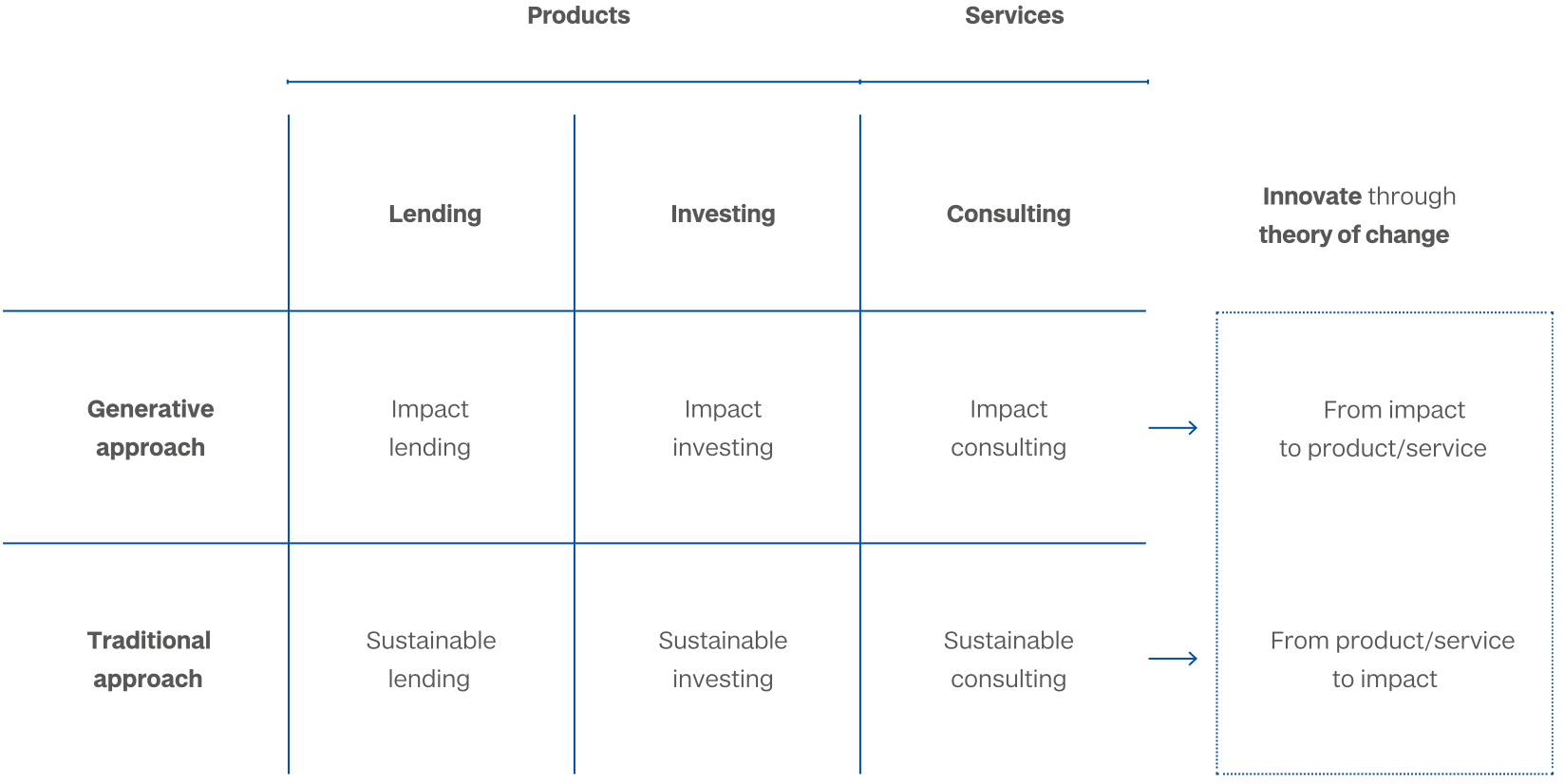
There are two possible approaches to impact: (i) generative approach and (ii) traditional approach:
- Generative approach - In this case, impact is the direct result of the delivery of a new product or service designed to maximize the creation of a positive impact. This approach produces a return that is both financial and socio-environmental, namely a positive effect on society (for example, increased life expectancy or better welfare conditions in a specific geographic area). In this context, the Theory of Change (see Appendix 2) can be a useful tool for designing new “impact by design” products/services in various areas (lending, investing, and consulting). Starting from the long-term impact objectives that the Sella Group aims to generate for society, it is possible to identify the short-term changes (outcomes) that can be achieved on specific target customers, and then develop a new offering (outputs).
- Traditional approach - This approach refers to impacts from sustainable activities that, while not directly related to an “impact by design” product, are oriented towards investing in and financing specific targets (individuals or businesses) adopting a sustainability perspective. This implies a potential shift of products towards a generative approach using the Theory of Change. Indeed, it is possible by means of a detailed analysis of the purposes of existing sustainable products/services to understand the effects and changes generated in the short and long term on the direct beneficiaries ( individuals or businesses) and on society in general.
Within the two approaches, it is possible to find products such as:
- Impact Lending - Lending activities aimed at beneficiaries (individuals or organizations) having the objective of generating a measurable, positive social and/or environmental impact compatible with an economic return. Financial products include Impact-Linked Loans, which are similar to traditional loans except that the interest rates (and, in some cases, also the repayment obligations) are linked to the achievement of predefined social and/or environmental objectives. The customer benefits from a “better terms for better impact” rule - the greater the impact achieved, the lower the interest rate to be paid.
- Impact investing - The activity of investing in businesses, organizations and funds whose business is designed to generate a measurable, positive social and/or environmental impact compatible with an economic return. The main financial products include:
- Private Equity/Debt and Venture Capital Funds (closed-end funds) - Funds that invest in debt or equity instruments with the objective of generating positive impacts on society, as well as a financial return. These funds focus on non-listed companies and/or specific impact investing segments.
- Public Market Funds (open-ended funds): Investment funds that focus on stocks, bonds or other listed financial instruments that have the objective of generating positive social and/or environmental impacts in addition to a financial return. These funds operate in open financial markets in which companies are already listed and the capital invested is used to pursue impact objectives.
- Some Green, Social, or Sustainable bonds possessing the right characteristics.
- Sustainable Lending - Financing designed to support projects, companies or initiatives that promote sustainable Environmental, Social and Governance (ESG) practices. Among the financial products already available from the Sella Group, we can mention Energia Pulita (Clean Energy Loan), Prestito Green (Green Loan), Mutuo Green (Green Mortgage), Sustainability-linked Loan, and many others, all of which aim to support customers in their efforts to make green transition choices.
- Sustainable Investing - Activities to ensure that investments comply with ESG principles to promote long-term sustainability. Such investments focus on managing ESG risks and integrating these factors into investment decisions. ESG principles are generally evaluated in relation to the organization receiving the investment. Examples of sustainable investment products include Green, Social and Sustainability Bonds, bonds issued by public and private organizations that operate following a sustainable approach and invest in initiatives aimed at generating positive social and/or environmental outcomes. These instruments also include intentionality and measurement requirements, alongside an economic return for the investors.
Finally, the services available are:
- Impact consulting - Guiding customers toward investment and lending choices that generate a positive and measurable impact with respect to defined social or environmental aspects, as well as an economic return. Consulting may also include supporting companies with designing positive impact initiatives, and helping them monitor, measure, and communicate the effectiveness of these initiatives in a transparent manner.
- Sustainability consulting - Guiding customers towards sustainable investment and lending choices promoting a growth model able to mitigate Environmental, Social and Governance risks.